What it is
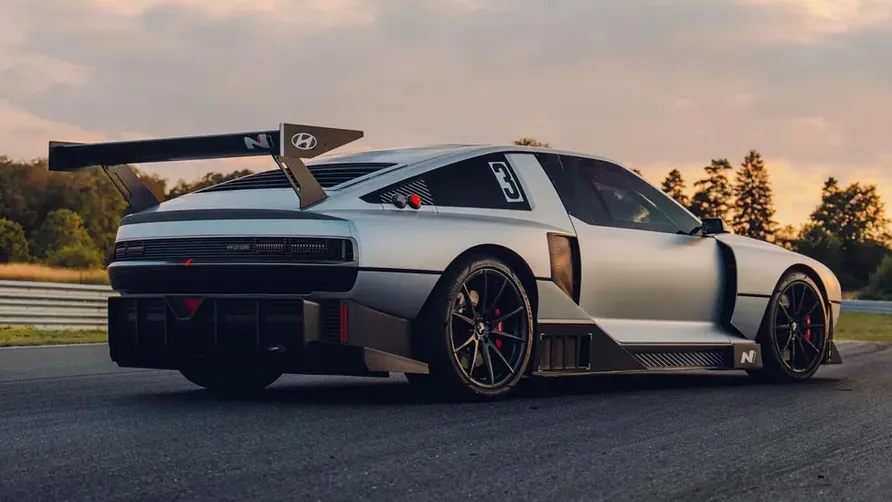
Hyundai's N performance division unveiled the N Vision 74 in July 2022 as a “rolling lab”: a drivable prototype for testing high-performance electrified powertrains. It combines a hydrogen fuel cell with a plug-in battery, sending power to two motors on the rear axle. Journalists drove it on track in Germany that September, and it has been a fixture at shows and events since.
Powertrain
| Fuel cell | 85 kW net (95 kW peak) stack derived from the Hyundai Nexo |
| Battery | 62.4 kWh, T-shaped pack, 800-volt fast charging |
| Motors | Two, one per rear wheel, with torque vectoring |
| Combined output | About 670 hp (500 kW) and 664 lb-ft |
| Hydrogen storage | Two tanks, 4.2 kg total at 700 bar |
| Claimed range | Over 370 miles (600 km) |
In steady driving the fuel cell supplies the motors and tops up the battery. Under hard acceleration the battery does most of the work and the fuel cell acts as a range extender. The idea is to avoid the fade battery-only performance cars suffer on track as their packs heat up: the car has three separate cooling circuits, for battery, fuel cell and motors.
Performance
Hyundai quotes 0 to 62 mph in under four seconds and a top speed above 155 mph, at a weight of roughly 2,500 kg (about 5,500 lb). Reviewers who drove it at the Bilster Berg circuit praised its steering, brakes and the way torque vectoring disguised the mass.
Design
The shape is a tribute to the 1974 Hyundai Pony Coupe concept by Giorgetto Giugiaro, the designer of the DeLorean DMC-12 and the first Volkswagen Golf. The Pony Coupe never reached production. The N Vision 74's folded-paper wedge, louvered rear window and pixel lights carry that design forward, and it has won several international design awards.
Will it be built?
Hyundai has signaled more than once that it intends to put a car based on the N Vision 74 into limited production before 2030, and it appeared in the company's product roadmap shown to investors in 2024. Hyundai has not confirmed a price, a volume, a market list, or whether a production car would keep the hydrogen fuel cell. Treat numbers you see online for any of those as speculation until Hyundai publishes them.
Fueling one
If a hydrogen version reached U.S. customers it would use the same H70 stations as a Mirai or Nexo. Today that means California, where there are 37 open public stations. Because the N Vision 74 also plugs in, it would be less dependent on them than any current fuel cell car. See the station tracker for the current network and the refueling guide for how H70 fueling works.